
Chinese Black Tea Explained: Souchong, Congou, and How They Differ from CTC
Overview
Black tea is the most widely consumed tea type in the world, accounting for roughly 75–80% of global tea trade. Yet the term "black tea" hides a remarkable amount of diversity. Within China, the world's birthplace of black tea, producers distinguish several distinct families based on origin, cultivar, and manufacturing method. Meanwhile, the global commodity market is dominated by a completely different style known as CTC — a mechanized process that produces the granular tea found in most tea bags.
Understanding the difference between Chinese orthodox black tea and CTC black tea is essential for importers, brand owners, and tea professionals. The two are not merely different grades of the same product — they are fundamentally different manufacturing philosophies, producing teas with different chemistry, sensory profiles, pricing structures, and end-use applications.
First, a Critical Clarification for International Buyers
In English, "black tea" refers to what Chinese calls 红茶 (hóngchá) — tea that has been fully oxidized (often described as "fully fermented" in the Chinese tradition). Its liquor is typically dark red-brown.
This is not the same as Chinese 黑茶 (hēichá), which is literally translated as "black tea" but is properly called dark tea in English. Dark tea undergoes post-fermentation by microorganisms (as in Pu-erh) and produces a very different product.
This naming collision causes real commercial confusion. A buyer requesting "Chinese black tea" and receiving dark tea — or vice versa — is describing two entirely different products with different regulations, pricing, and applications.
For the remainder of this article, "black tea" means 红茶, the fully oxidized tea.
The Three Main Families of Chinese Black Tea
Chinese black tea is traditionally divided into three broad categories:
Souchong black tea (小种红茶) — the oldest style, with a distinctive smoking tradition
Congou black tea (工夫红茶) — the largest and most diverse category, made from whole leaves with meticulous craftsmanship
Broken black tea (红碎茶) — leaf grades produced for blending and export
1. Souchong Black Tea (小种红茶)
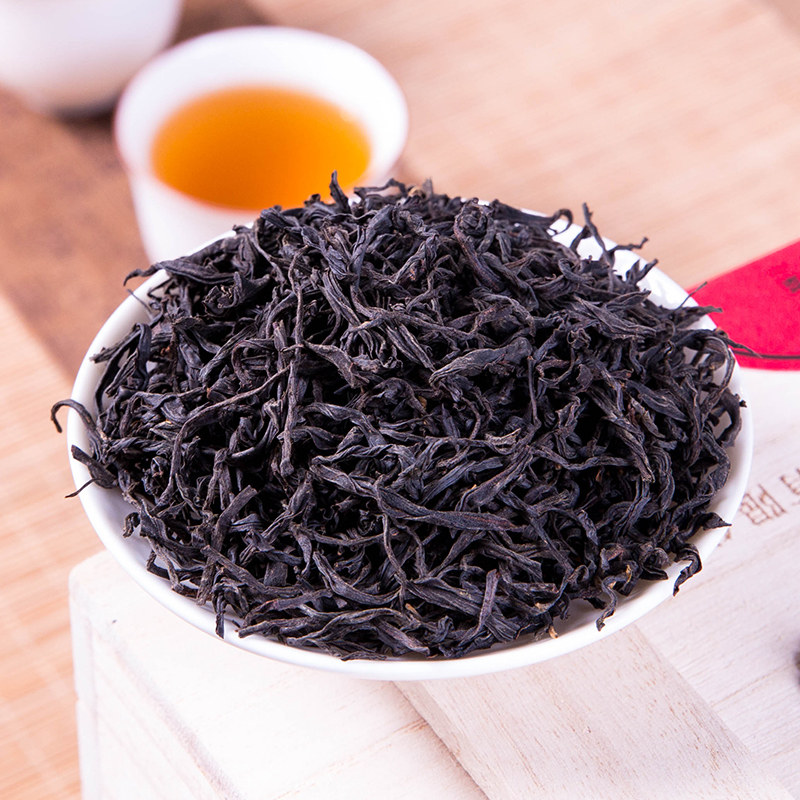
Origin: Tongmu Village, Wuyi Mountains, Fujian Province
Souchong is historically the world's first black tea, with records dating to the late Ming dynasty (around the 16th–17th century). The name derives from siu chung (小种), meaning "small variety" or "rare variety," referring to the small-leaf local cultivar.
Production characteristics:
Withering over heated "green towers" (青楼)
Rolling
Oxidation
Drying over smoldering pine wood — the defining step for smoked versions
Pine smoke absorption gives a distinctive resinous, smoky character
Two sub-styles:
| Style | Description |
|---|---|
| Smoked Souchong (烟小种) | Dried over pine fires; pronounced pine-smoke, longan-like sweetness. The classic "Lapsang Souchong" of Western markets. |
| Unsmoked Souchong (无烟小种) | Modern style without smoke; emphasizes the tea's natural sweetness, floral and cocoa notes. |
Notable modern developments:
Jin Jun Mei (金骏眉) — developed in 2005, this is a premium unsmoked tea made exclusively from single buds of the Tongmu cultivar. It sparked a significant revival in Chinese black tea consumption and commands very high prices.
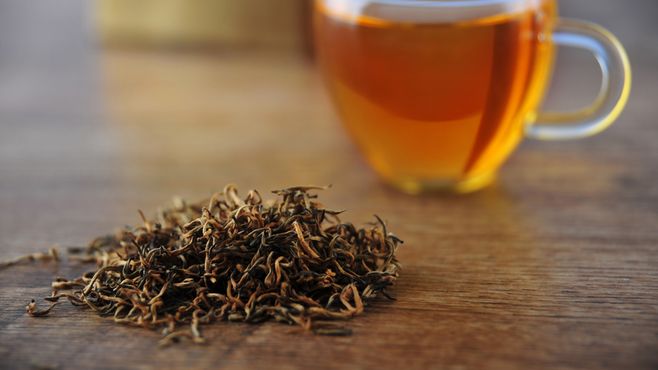
Yin Jun Mei (银骏眉) — made from one bud and one leaf, a slightly lower grade following the same concept.
Sensory profile: depending on style, expect pine smoke and dried longan (smoked), or honey, cocoa, floral, and a smooth, sweet finish (unsmoked).
2. Congou Black Tea (工夫红茶)

"Congou" is the historical romanization of gongfu (工夫), meaning "skill" or "effort." The name reflects the labor-intensive, whole-leaf orthodox manufacturing that defines this category. Congou is the largest category of Chinese black tea and encompasses nearly all of China's famous regional black teas.
Standard orthodox manufacturing process:
Withering — reducing moisture to make leaves pliable
Rolling — breaking cell walls to initiate oxidation and shape the leaf
Oxidation (发酵) — the critical stage; polyphenols are converted by polyphenol oxidase, developing theaflavins and thearubigins
Drying — halting oxidation and fixing the flavor
Sorting and grading — separating leaf grades
Major regional Congou varieties:
| Tea | Region | Character |
|---|---|---|
| Keemun Congou (祁门红茶) | Qimen, Anhui | Orchid, fruity, cocoa, wine-like. Historically described as the "Burgundy of teas." The benchmark Chinese black tea in Western markets. |
| Dianhong (滇红) | Yunnan | Made from Yunnan large-leaf (assamica) cultivar. Bold, malty, honeyed, with abundant golden tips. High extract yield. |
| Yihong (宜红) | Yichang, Hubei | Known for a mellow, sweet, brisk cup with a clean finish. A classic mid-China Congou with a long export history. |
| Ninghong (宁红) | Xiushui, Jiangxi | Full-bodied, brisk, with a distinctive "fruit-sweet" note. |
| Chuanhong (川红) | Sichuan | Bright, brisk, with a fresh, slightly citrusy character. |
| Minhong (闽红) | Fujian | Three sub-styles: Tanyang Gongfu (bright, floral), Bailin Gongfu (fine, silky, honeyed), Zhenghe Gongfu (rich, mellow). |
| Huhong (湖红) | Hunan | Robust, full-bodied, good for blending. |
| Yingde Black Tea (英德红茶) | Guangdong | Strong, bright, high in extracts; widely used for milk tea and iced tea applications. |
| Qianhong / Yuehong | Guizhou / Zhejiang | Regional Congou styles, often used in blends. |
Grading of orthodox leaf: Western trade grades such as OP (Orange Pekoe), FOP (Flowery Orange Pekoe), FBOP, TGFOP, and SFTGFOP describe leaf size and tip content. These are not quality guarantees on their own — a smaller uniform grade can outperform a nominally higher grade in the cup.
3. Broken Black Tea (红碎茶)
China also produces broken-leaf black teas, primarily for export blending. These are distinct from CTC in that they are still produced using orthodox methods — the leaf is simply broken into smaller, uniform pieces rather than crushed into granular pellets.
Characteristics:
Faster extraction than whole leaf
More consistent particle size for blending
Lighter, brighter cup than CTC, with more aromatic complexity
Higher price than CTC, lower than whole-leaf Congou
What Is CTC Black Tea?
CTC stands for Crush, Tear, Curl — a mechanized processing method invented in Assam, India, around 1930. It was developed to industrialize black tea production and dramatically increase output speed in response to growing global demand.
The CTC Process
Rather than rolling whole leaves, CTC machines pass withered and oxidized leaf through a series of toothed rollers that crush, tear, and curl the leaf into small, granular pellets.
Key process differences:
| Aspect | Orthodox (Chinese Congou) | CTC |
|---|---|---|
| Leaf handling | Whole leaves preserved and shaped | Leaves crushed into granules |
| Rolling | Gentle, repeated rolling | Toothed rollers, high pressure |
| Oxidation | Controlled, gradual; often 2–4 hours | Rapid and near-complete; often under 1–2 hours |
| Cell rupture | Partial and controlled | Extensive and immediate |
| Production speed | Slow, labor-intensive | Very fast, highly mechanized |
| Yield per kg fresh leaf | Lower | Higher |
| Labor intensity | High | Low |
| Typical cost | Higher | Lower |
| Primary use | Specialty, retail, premium blends | Tea bags, milk tea, iced tea, masala chai |
CTC Grades
CTC teas are graded by particle size rather than leaf style:
| Grade | Description |
|---|---|
| BP (Broken Pekoe) | Larger granules |
| BPS (Broken Pekoe Souchong) | Slightly smaller |
| PF (Pekoe Fannings) | Small, fast-brewing; common in tea bags |
| PD (Pekoe Dust) | Very fine; brisk and strong |
| D (Dust) | Finest; strongest, fastest extraction |
| OF (Orange Fannings) | Fine grade, widely used in blends |
Note that CTC grade names share vocabulary with orthodox grades, but they describe particle size, not leaf quality — a frequent source of buyer confusion.
Sensory and Chemical Differences
The manufacturing difference produces measurable chemical and sensory gaps.
| Dimension | Chinese Orthodox Black Tea | CTC Black Tea |
|---|---|---|
| Dry leaf appearance | Whole, twisted, wiry, often golden-tipped | Small, uniform, dark granular pellets |
| Liquor color | Clear, bright amber to red-brown | Deep, dense, opaque red-brown |
| Aroma complexity | High — layered floral, fruity, cocoa, woody notes | Moderate — straightforward, malty, sometimes slightly harsh |
| Body | Medium to full, often with texture and depth | Heavy and assertive; fills the mouth quickly |
| Astringency | Balanced, integrated | Pronounced, sometimes aggressive |
| Extraction speed | Slower; supports multiple infusions | Very fast; typically single infusion |
| Re-steepability | Good — 3 to 6+ infusions for premium teas | Poor — exhausted after one or two |
| Variance between lots | High (terroir, season, craft) | Low (industrial consistency) |
| Consistency | Variable by design | Highly standardized |
Why the difference? Orthodox processing preserves intact leaf structure, so compounds are extracted gradually and unevenly, giving layered flavor development. CTC processing ruptures nearly all cell walls at once, so a large fraction of soluble compounds — including theaflavins and thearubigins responsible for briskness and color — is released immediately. This produces a strong, dark, fast-brewing liquor, which is exactly what tea bag and milk-tea applications require.
Why This Matters Commercially
Understanding the orthodox/CTC divide has direct commercial consequences:
For Tea Bags
Mass-market tea bags are overwhelmingly filled with CTC fannings or dust because they extract quickly and deliver consistent strength in a 2–3 minute brew. A whole-leaf Chinese Congou in a standard tea bag brews too slowly and too weakly for the typical consumer.
For Milk Tea and Chai
CTC is the standard base for masala chai and most milk teas because its assertive, astringent character survives dilution with milk and sugar. Orthodox teas can be used for premium milk tea, but the cost is higher and the flavor profile must justify it.
For Specialty Retail
Whole-leaf Chinese orthodox teas — Keemun, Dianhong, Jin Jun Mei, Tanyang Gongfu — are positioned in the specialty and premium segment. They command significantly higher prices per kilogram and are sold on origin, craft, and flavor complexity rather than on strength.
For Pricing
CTC is a commodity: traded in large volumes, priced on a global auction basis, and highly sensitive to supply conditions in Kenya, India, Sri Lanka, and Vietnam. Orthodox Chinese black tea is closer to a specialty agricultural product: priced by origin, grade, harvest, and craft reputation.
The two are therefore not direct substitutes. A buyer seeking a cost-efficient tea bag filler and a buyer seeking a distinctive single-origin premium tea are operating in different markets, even though both are purchasing "black tea."
For Regulations and Origin Claims
Whole-leaf orthodox teas carry a clear origin identity and are better suited to geographical indication claims and single-origin labeling. CTC is typically blended across multiple origins, making traceability claims more complex.
Brewing Guidance
| Orthodox Chinese Black Tea | CTC Black Tea | |
|---|---|---|
| Water temperature | 90–95°C | 95–100°C |
| Leaf-to-water ratio | 3–5 g per 150 ml | 2–3 g per 150 ml |
| Steep time | 2–4 minutes (first infusion) | 2–3 minutes |
| Re-steeping | Yes, 3–6 infusions | Generally no |
| Best for | Gongfu brewing, straight drinking | Tea bags, milk tea, iced tea |
Note: Boiling water can flatten the aroma of delicate, high-grade orthodox teas such as Jin Jun Mei. Slightly cooler water preserves their floral and honeyed notes.
Conclusion
Chinese black tea and CTC black tea are the products of two different worlds. Chinese black tea — whether a smoky Souchong from the Wuyi Mountains or a malty Dianhong from Yunnan — is the product of origin, cultivar, and craft, built for complexity, aroma, and re-steepability. CTC is the product of industrial engineering, built for speed, strength, consistency, and low cost.
Neither is inherently superior. They serve different markets and different consumers. But for anyone sourcing black tea internationally, knowing which family a product belongs to — and why — is the first step toward buying well.
Source: Compiled and analyzed based on publicly available industry data